

On11 October 2025, Rome will be the scene of an event announced by WEFI, a platform that calls itself the ‘world’s first Deobank’. In the materials disseminated to promote the initiative, the image of the Colosseum, chosen as the background for the official poster, stands out. This is not a minor graphic detail: the use of Italy’s most iconic monument represents a precise communication strategy. Associating an emerging financial project with a national symbol of global recognition means trying to transfer onto it an aura of solidity, prestige and cultural rootedness. It is a technique already seen in other contexts: exploiting universally recognised places or figures to legitimise initiatives that, on the contrary, have no legal or financial basis comparable to those they evoke. The poster shows not only the Colosseum, but also John Sachtouras, presented as Community Development Officer. His image stands next to the monument, creating a visual combination that aims to reassure the Italian public: on the one hand the country’s cultural heritage, on the other an international face associated with titles and awards. But precisely this combination, when analysed carefully, reveals more contradictions than certainties.
John Sachtouras: a career in network marketing
To understand Sachtouras’ role in WEFI one has to look at his career, during which he has built his image through decades in network marketing. He is the founder of Ascira Global, a course and training package platform that presents itself as a lifestyle and personal growth community. In reality, Ascira has adopted a classic multilevel marketing (MLM) model: multi-level subscriptions, recruitment-related commissions, and heavy reliance on new members joining. Several observers have compared Ascira to familiar pyramid schemes, pointing out that the main revenues do not come from the sale of educational content, but from the flow of memberships.
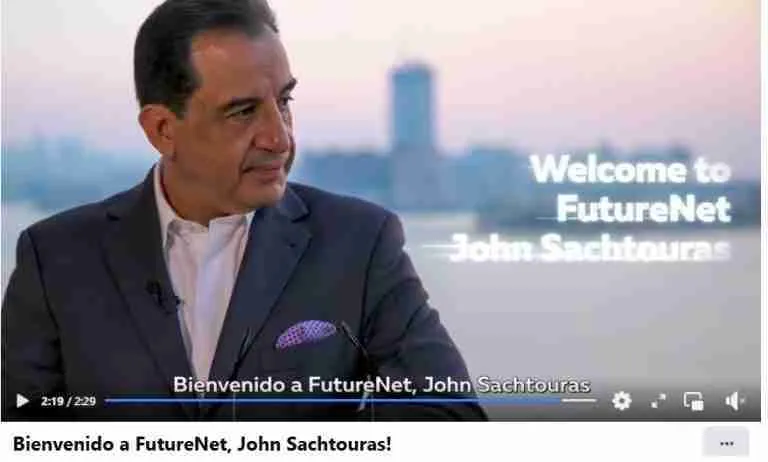
Sachtouras’ name also appears in promotional material for FutureNet, a platform that promised a profitable decentralised social network. In one video, the words ‘Welcome to FutureNet – John Sachtouras’ appear.


FutureNet was subsequently criticised and reported by the Polish Consob as a Ponzi scheme, demonstrating a recurring pattern: Sachtouras lends its image to controversial projects that rely on rhetoric of innovation and financial freedom.
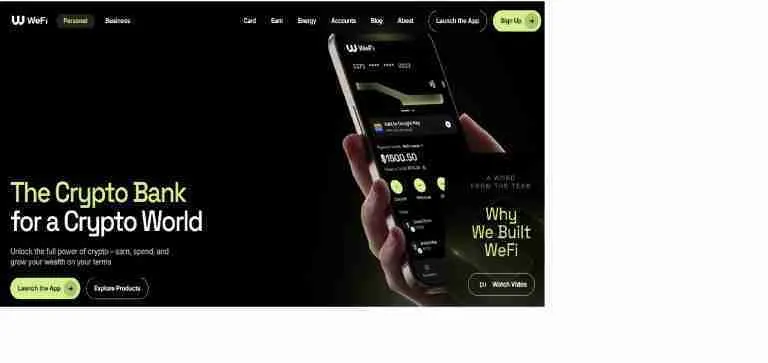
WEFI: the promise of Deobank
WeFi presents itself as the ‘world’s first Deobank’, a concept that aims to combine the decentralisation typical of blockchain with traditional banking services. In official promotional materials, the company promises non-custodial accounts, globally accepted physical and virtual Visa cards, and access to over 7,000 digital assets. At the core of the ecosystem are the proprietary WeChain blockchain, the WFI token and an internal stablecoin called WUSD, described as a tool for remittances, cashback and payments. An element of gamification is the ‘Energy’ system, which allows users to accumulate points to reduce fees and increase benefits. WeFi’s advertising campaigns also speak of a ‘Mining Boost +10%’ and, above all, of returns of up to 18% per year on stablecoins, an explicit promise stated on the site and in materials disseminated by the company.
This is where statements collide with the reality of financial markets: the promised returns on stablecoins are not sustainable in any regulated environment. This is a level of return that historically characterises Ponzi schemes or high-risk platforms, not solid decentralised banks. Even the reference to ‘mining without hardware’ remains vague and difficult to reconcile with known validation or staking models. The distance between the promotional narrative and the real economic parameters is therefore significant. More than a banking revolution, WeFi presents itself as a project that draws on the language of decentralisation and digital finance to attract investors with promises of exceptional gains, but without demonstrating transparent and sustainable mechanisms.
WeChain: the ‘permissioned’ blockchain that does not convince
In official documents, WeChain is described as a permissioned blockchain built on the Cosmos architecture, intended for banks, fintechs and regulators. In theory, any approved institution can manage validator nodes (ITO validators) and provide services such as neobanks, remittances, stablecoins or KYC platforms. However, the permissioned model implies that access to nodes is not as free as in permissionless networks such as Bitcoin or Ethereum: only entities selected by the central operator or the validator programme are allowed in. The documentation speaks of a ‘decentralised’ ecosystem, but does not specify who approves the nodes, how decision-making power is distributed or what the governance criteria are. Furthermore, there are no public independent audits of the code or the functioning of the validators. The absence of this information makes governance opaque and leaves open doubts as to whether decentralisation is really taking place. The risk, therefore, is that WeChain is configured as a closed and centralised network masquerading as a blockchain innovation. If this were the case, the difference with respect to a traditional database would be minimal: the ‘blockchain’ label would become more of a marketing tool than a technological guarantee of transparency and power distribution.
The WUSD stablecoin and the link with Tether
A declared pillar of the ecosystem is the stablecoin WUSD, designed to replicate the value of the dollar. In the official materials, however, no information is given about the reserves that should support its peg, nor are there any independent audits to guarantee stability. The point becomes crucial because in the project appears the name of Reeve Collins, chairman of WEFI and co-founder of Tether, which is now the most widespread stablecoin in the world, but its history remains marked by controversy over the transparency of its reserves. Until 2019, it claimed that each USDT was backed by one real dollar; after investigations by the New York Attorney General, the formula was changed to ‘backed by Tether’s reserves’, without clearly specifying its composition. In 2021, the company also paid a $41.6 million fine to the CFTC for misleading statements on hedging. The parallels with WUSD are obvious: if the market-leading stablecoin, albeit with global controls and scale, continues to show areas of opacity, the credibility of a currency within an unregulated project like WEFI appears even more fragile. The association with Collins reinforces the impression that WUSD re-proposes the same model of trust on the word, without real guarantees.
Fireblocks: real partnership or marketing leverage?
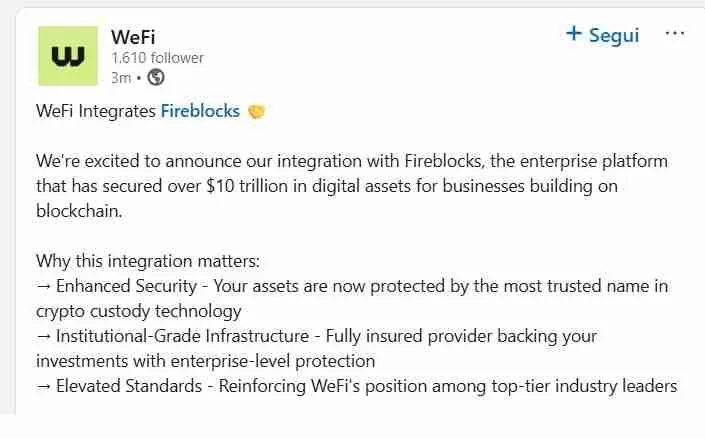
Another element of the narrative is the partnership with Fireblocks, a leading digital asset custodian, which is actually used by banks and regulated funds, so its name carries a lot of weight. WEFI mentions it as a partner, but there are no official statements from Fireblocks or audits certifying the integration. References only come from LinkedIn posts and the white paper. The comparison with other realities is enlightening: when Fireblocks collaborates with banking institutions or investment funds, official releases, contracts and technical details are published. Nothing similar happened with WEFI. It is therefore likely that the name is used as a communication sticker rather than as proof of security.
Paid editorials: how reputation building works
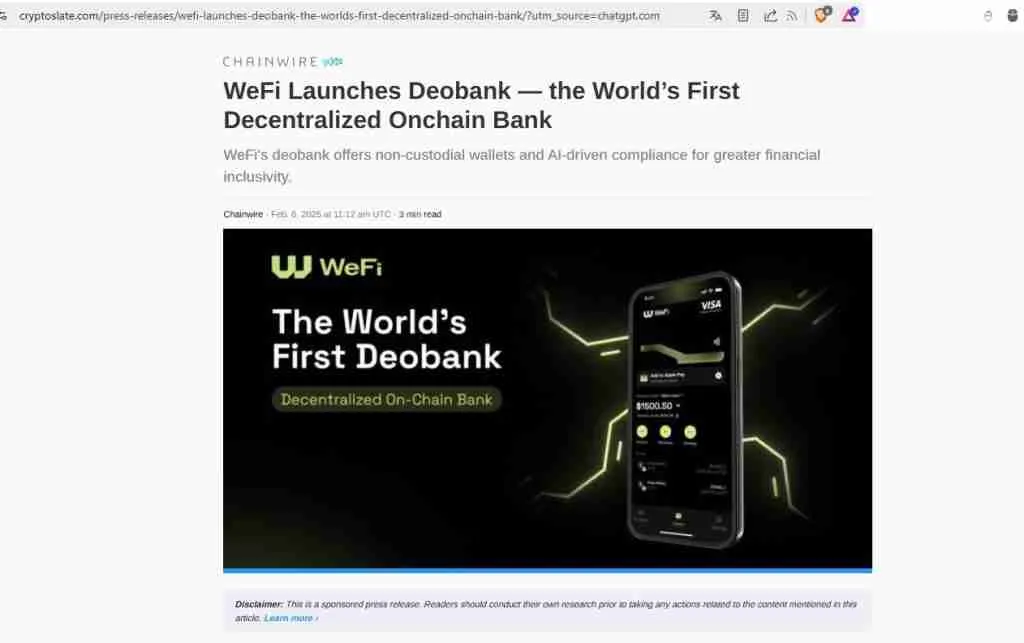
WEFI has been celebrated by articles in prestigious publications such as Forbes, Nasdaq, Cointelegraph, Investing.com and Finbold, as well as on channels within the Binance ecosystem. However, these are paid editorials or branded content. An advertorial works like this: a company pays a media outlet to publish a positive article, written in journalistic form but without contradiction. Costs vary: publishing in Forbes BrandVoice can cost tens of thousands of dollars. These articles are then used as marketing tools: ‘we are on Forbes’, ‘we are on Nasdaq’. In reality they are not surveys, but advertising in disguise. It is a legitimate practice in commercial terms, but a dangerous one in the financial sector because it leads the public to believe in an authoritativeness that is not there. It is the same mechanism already seen in projects such as OneCoin or BitConnect, which in the first months boasted of appearances in international newspapers bought with editorial packages. Another powerful marketing tool used by Wefi’s promoters is the mention of the fact that it won the ‘Best Digital Bank of the Year’ award at the FinanceFeeds Awards 2025 thanks to its Deobank model, according to a FinanceFeeds article extolling its crypto Visa cards, multi-layered security, on-chain presence and global digital experience. This recognition, while conspicuous, is part of a broader strategy: that of emphasising titles, awards and industry mentions as a powerful reputational marketing lever, rather than as proof of transparency, economic soundness or independent governance.
Independent investigations: BehindMLM and Danny de Hek
The corporate structure
BehindMLM analysed the domains linked to WEFI and reconstructed the companies involved: Canada (WeFi Payments Limited, registered as an MSB, not a bank), Costa Rica, Hong Kong, St. Vincent and St. Kitts & Nevis. It is a network of shell companies in opaque jurisdictions.
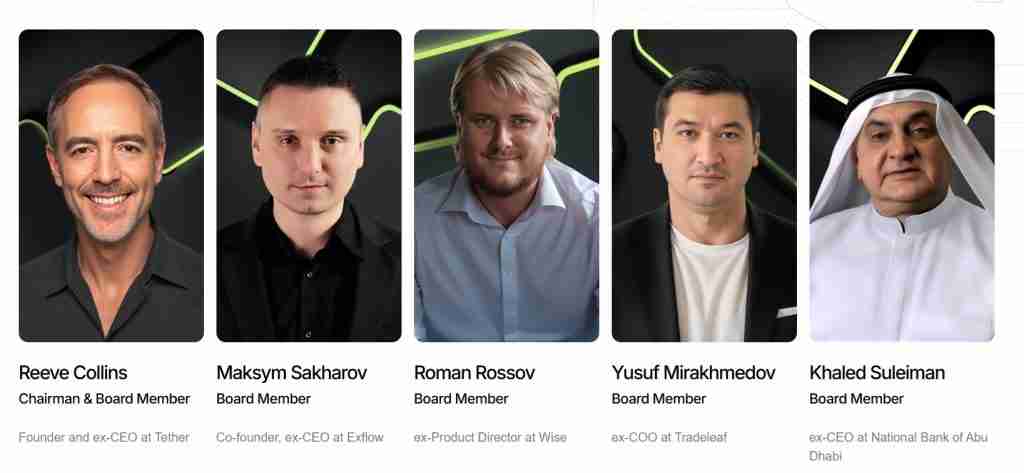
The board
The board includes figures such as Reeve Collins and especially Yusuf Mirakhmedov, former CEO of Feni Industries and Ferronickel.
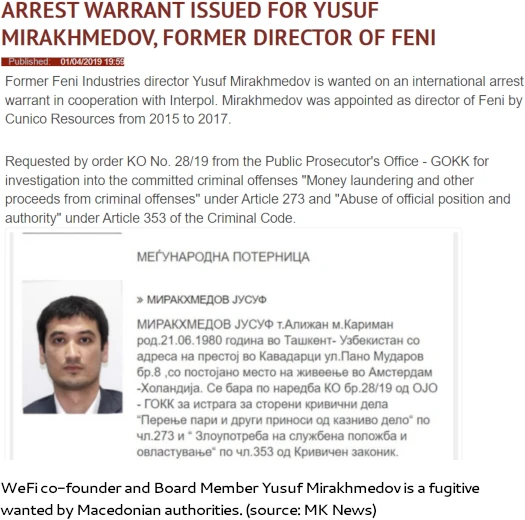
The Mirakhmedov case
Among the WEFI board members is a name that weighs like a boulder: Yusuf Mirakhmedov, former CEO of Feni Industries and Ferronickel, a company of the Cunico Resources group.
- 2015: appointed managing director of Feni Industries, a leading ferro-nickel producer in Macedonia.
- 2017: accused of embezzling over USD 50 million and orchestrating opaque financial transactions that allegedly impoverished the company.
- 2019: An international arrest warrant is issued by the Macedonian authorities.
According to local press and investigative reports, Mirakhmedov allegedly created a network of shell companies to drain capital, leaving Feni Industries on the brink of bankruptcy and thousands of workers without prospects. Today, he is reported to be living in Dubai, where he presents himself as an entrepreneur linked to the crypto and fintech sector. His presence on the board of a project that aspires to manage the funds and sensitive data of global users is an obvious red flag. He is not just a ‘questionable name’: he is an individual with a past marked by serious criminal charges and international court proceedings. The inclusion of Mirakhmedov fundamentally undermines WEFI’s credibility, confirming the hypothesis that it is an operation more concerned with raising easy capital than ensuring transparency and stability.
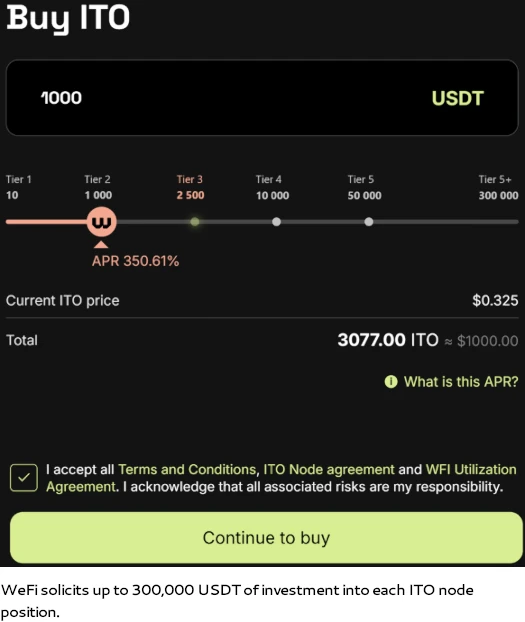
The Ponzi model
According to BehindMLM and Danny de Hek, WEFI does not offer real products but only investment positions in ITO Nodes purchased in USDT. The promises of ROI of up to 350% per annum, staking programmes at 15-25% and recruitment-related commissions are characteristics of a multi-level Ponzi scheme.
Privacy policy
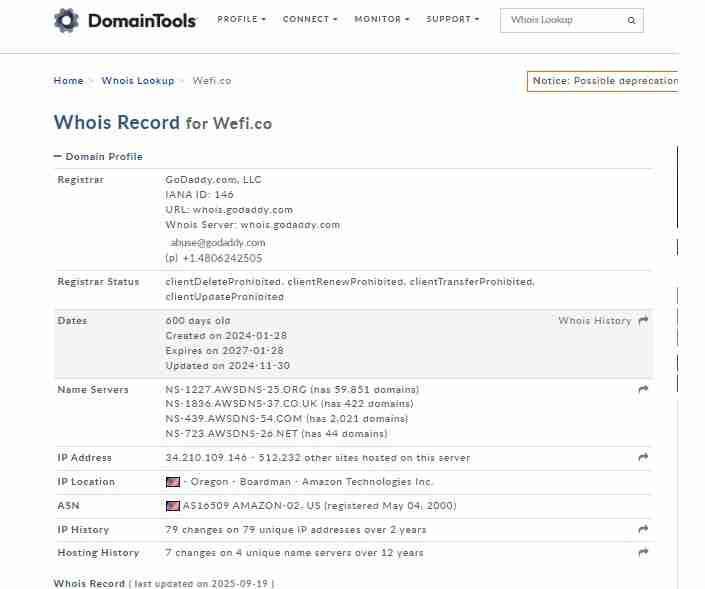
WHOIS analysis: opaque domains and recent registrations
The WHOIS analysis of the top domains confirms the lack of transparency.
- wefi[.]co: registered in January 2024, WHOIS data obscured with registrar privacy.
- wechain[.]ai: registered in May 2024, also with WHOIS protection.
- ito.wechain[.]ai: rated by Scamadviser with low trust score for opaque hosting and negative reviews.
The choice to conceal the identity of the registrants and such a recent recording belie the narrative of a project with deep roots.
Target markets and web traffic
According to SimilarWeb, WEFI recorded around 130,000 visits per month as of August 2025. Most of the traffic comes from Vietnam, Ecuador, France, Thailand and Germany. WeChain receives visits mainly from Canada, Brazil and India.
Concentration in countries with weaker regulations is typical of global MLM schemes.
Italy as a vulnerable market
Bringing an event to Rome and using the Colosseum as a symbol means targeting a country already exposed to numerous Ponzi schemes. In the past, thousands of Italian savers have been hit by platforms such as Wewe.global, Uefa football, Swag Your Life and countless unauthorised online trading companies. The promise of easy returns, combined with the use of technological language and international testimonials, creates fertile ground for attracting inexperienced investors. In the absence of timely controls, Italy risks becoming one of WEFI’s main markets.
Final Evaluation
Behind the rhetoric of the ‘Deobank’, WEFI shows all the traits of a multi-level Ponzi scheme:
- promises of unrealistic returns,
- absence of bank licences,
- companies registered in opaque jurisdictions,
- board with severely compromised figures,
- reputation built through paid editorials,
- amateurish handling of sensitive data.
The figure of John Sachtouras, with his background in network marketing, token awards and appointments in unverifiable bodies, serves to construct a perceived status that does not correspond to substance.
The event in Rome is not the beginning of a new banking era. It is an attempt to legitimise a project that exposes savers to enormous risks, both economic and security.